Average Reviews:

(More customer reviews)Are you looking to buy Inside Drucker's Brain? Here is the right place to find the great deals. we can offer discounts of up to 90% on Inside Drucker's Brain. Check out the link below:
>> Click Here to See Compare Prices and Get the Best Offers
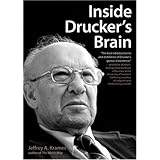
Inside Drucker's Brain ReviewI have read and then reviewed more than 40 books by or about Peter Drucker (November 19, 1909-November 11, 2005) as well most of Jeffrey Krames's books. You can thus understand why I was so eager to read Krames's latest, Inside Drucker's Brain, in which he shares what he learned during an extended interview of Drucker in Claremont (CA) in late-December in 2003. As indicated in his earlier books (notably Jack Welch and the 4E's of Leadership, The Welch, and What the Best CEOs Know), Krames conducts rigorous and extensive research and thus was well prepared for what proved to be one of Drucker's last interviews. By then he was 94 when Krames arrived at his home "and he looked every one of those years. He appeared thin and frail. His glasses were thicker than I had imagined, and his hearing aids were very conspicuous. However, it did not take long to discern the sharp mind behind the bespectacled, aged face...He had his own agenda, and was anxious to get started."
Personal digression: How much I wish I could have had the opportunity to take social science and management courses from Drucker that he taught at what is now the Peter Drucker and Msatoshi Ito Graduate School of Management at Claremont University. For an eyewitness account, please check out William Cohen's A Class with Drucker: The Lost Lessons of the World's Greatest Management Teacher.
Although Krames indicates that, by the time they met, Drucker's physical health had deteriorated and he could no longer continue his classroom teaching, what Krames found inside Drucker's mind was an abundance of information, insights, and wisdom. Even at that advanced age, Drucker's focus was on timely and timeless issues of greatest importance to him. He indicated little (if any) interest in reminiscences. (Those who have elderly relatives can attest to how remarkable that is.) Ducker's intellectual curiosity remained insatiable as he shared with Krames (and with us) his thoughts about subjects such as these:
1. Barriers to effective execution (Chapter 2)
2. Minimizing failed policies, unsound methods, and bad habits (Chapter 3)
3. "Eight Realities" for every manager (Chapter 4)
4. Dominant characteristics of "naturals" (Chapter 5)
Note: In Drucker's view, a "natural" sets the right priorities, inspires others, and knows how to make "life-and-death situations. Naturals do not micromanage people to death. They understand intuitively that autocratic leaders are not effective and part of the problem."
5. Establishing and then strengthening business "partnerships" (Chapter 6)
6. "Abandoning" organizational waste and obsolescence (Chapter 7)
7. Building on people's strengths (Chapter 8)
8. The traits and habits (i.e. critical factors) of the "ideal leader" (Chapter 9)
9. Why Jack Welch was the right leader at the right time for GE (Chapter 10)
10. Why people decisions are the most important questions (Chapter 11)
11. Why Drucker thinks so highly of Jeff Bezos (Chapter 12)
12. The changing role of information in a business environment (Chapter 13)
13. An effective leader's core competencies (Chapter 14)
14. Determining what a customer-centric business must become (Chapter 15)
Note: In Chapter 15, Krames provides what he calls "A Short Course on Innovation" based on three of Drucker's core beliefs: Without a customer, there is no business; customer needs are constantly changing; and, companies must be "organized for innovation" (top to bottom) in order to respond effectively - and profitably - to whatever its customers' needs may be.
15. Important turning points in Drucker's life (Epilogue)
Others will have their own reasons for holding Krames's book (and its subject) in high regard. Here are three of mine. First, at no time while I was reading this book did it seem to me that Krames was shaping, manipulating, filtering, "massaging," or in any sense misrepresenting what Drucker shared with him. In fact, it took Krames about a year to listen to the tape recordings and then listen again to portions of them, a process complicated by Drucker's thick accent and hearing problem. To ensure that his account would be as authentic as possible, Krames also re-read several of Drucker's books, including one of my own personal favorites, Adventures of a Bystander, once described by Drucker as being (contrary to the subtitle of the British version) "no more 'a history of our times,' or even of 'my times,' that it is an autobiography." Credit Krames with a brilliant job of transcribing, organizing, and then presenting material so that his function is that of a bystander rather than of a self-serving link between Peter Drucker and those who read the book.
I also admire the fact that, when providing direct quotations from dozens of sources that express sometimes quite complicated concepts, Krames carefully creates an appropriate context for each. In his books and also, apparently, in his classroom discussions, consulting sessions, and personal conversations, Drucker had a tendency "for repetition, digression, and for bringing in unfathomable ideas that at times distracted [others] from his main thesis. It was as if his mind raced forward as he wrote [and spoke] and he had to work to keep up." Hence the importance of Krames's preparations prior to the extended interview and then of his post-interview efforts. I do not recall a single quotation in the entire book (whatever its source) for which Krames does not create a context.
Finally, I greatly appreciate having direct access (via Krames) to Drucker near the end of his life just as I greatly appreciate having access (via Cohen) to a much younger Drucker, then in his prime as a classroom instructor. Throughout his life, Drucker granted very few interviews, preferring to focus on his work rather than discuss it. There is still so much about his "life and times" that we will never know. With all due respect to Krames and others who have also written important books about Drucker, I remain convinced that the best way to get inside his brain is to read and then re-read what he has written. However, what Jeffrey Krames makes possible is to feel as if we are in Peter Drucker's presence, and Krames achieves that in ways and to an extent no one else has. Thank you.Inside Drucker's Brain Overview
Want to learn more information about Inside Drucker's Brain?
>> Click Here to See All Customer Reviews & Ratings Now

0 comments:
Post a Comment