Average Reviews:

(More customer reviews)Are you looking to buy Nice Guys Can Get the Corner Office: Eight Strategies for Winning in Business Without Being a Jerk? Here is the right place to find the great deals. we can offer discounts of up to 90% on Nice Guys Can Get the Corner Office: Eight Strategies for Winning in Business Without Being a Jerk. Check out the link below:
>> Click Here to See Compare Prices and Get the Best Offers
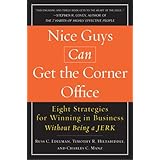
Nice Guys Can Get the Corner Office: Eight Strategies for Winning in Business Without Being a Jerk ReviewUp front, I need to clarify three key points. First, as Edelman, Hiltabiddle, and Manz explain in their Introduction, the word "nice" includes many positive, desirable attributes and is not about being weak or soft. They make several distinctions between being "nice" and "too nice." Also, their use of the word "guy" is not meant to be gender specific. Virtually all of the information [and advice] in this book is directly relevant to both men and women in the business world. In fact, 46 percent of the people surveyed for this book were women." Finally, it soon became obvious to me that "corner office" is used as a symbol for career success and has little (if anything) to do with the physical location of an executive's office.
This book can be of substantial benefit to both an executive who has a "nice guy" among her or his direct reports, and, to any "nice guy" who is currently frustrated by her or his career success thus far. Most of the material was generated by the authors' interviews of 22 CEOs, founders, and thought leaders whose responses supplemented, challenged, and confirmed the authors' thinking. They and their affiliations are identified on Pages 7-9 and their input is quoted throughout the narrative to help clarify a key point. It should also be noted that the authors conducted more than 350 surveys and obtained a statistical assessment from these surveys. For example, one of the data points is that 61% of the participants believe they are "too nice" in business and that 50% of them indicated that their managers are "too nice."
Others will have their own reasons for praising this book. Here are three of mine.
Edelman, Hiltabiddle, and Manz make brilliant use of several reader-friendly devices while devoting a Separate chapter to each of eight strategies recommended for "winning in business without being a jerk." These devices include Stories, Motives and Symptoms, Inventory, Controls, and then a Summary of key points at the conclusion of each chapter. Readers will appreciate these devices (especially the Summaries) because they will facilitate, indeed expedite frequent reviews of the key points later.
I also appreciate the fact that the authors have drawn upon an abundance of real-world experiences (theirs as well as their interviewees') because their focus throughout the book is on what achieves the desired results, what doesn't, and why. Presumably the information and advice they provide will help at least some executives who are "too nice" to become somewhat more effective but, in my opinion, the same information and advice will be of much greater value to other executives who are "nice" and more likely to make appropriate changes in how they interact with others. On Page 3, Edelman, Hiltabiddle, and Manz contrast the Old definition of "nice" (i.e. "A conditioned, well-intentioned approach to relationships") and the New definition of "nice" (i.e. "A constructive and consciously chosen approach to relationships"). Whereas someone who is "too nice" is always trying to please others, someone who is "nice" but effective strives to balance assertiveness with cooperation to achieve a spirit of collaboration.
Note: This compressed but enlightening cluster of key points re how Old and New definitions differ should be re-read several times while proceeding from one chapter to the next.
My third reason is that Edelman, Hiltabiddle, and Manz clearly demonstrate what Roger Martin has characterized as an "opposable mind": "the predisposition and the capacity to hold two [or more] diametrically opposed ideas" in his head and then "without panicking or simply settling for one alternative or the other," was able to "produce a synthesis that is superior to either opposing idea." That is, they agree with Warren Bennis, Bill George, Daniel Goleman, and James O'Toole (and countless others) that an effective leader must be "authentic" (i.e. true to herself or himself), develop a high level of emotional intelligence, be guided by a moral compass, and have the courage to bounce back from adversity. (Jack Dempsey once suggested that "champions get up when they can't.") The authors also agree with Larry Bossidy, Ram Charan, Jim Collins, and Jack Welch that leaders must be results-driven. (Thomas Edison asserted that "vision without execution is hallucination.") They welcome, indeed encourage productive confrontation, seeking what the authors describe as "optimal outcomes for everyone involved by emphasizing truthfulness and authenticity...embracing the innovation-promoting benefits of constructive idea conflict."
This review is somewhat longer than I originally anticipated but I realized while composing it that if I effectively suggest what it offers could be, it will attract the interest of those who will derive the greatest value from what Edelman, Hiltabiddle, and Manz present with both rigor and eloquence.Nice Guys Can Get the Corner Office: Eight Strategies for Winning in Business Without Being a Jerk Overview
Want to learn more information about Nice Guys Can Get the Corner Office: Eight Strategies for Winning in Business Without Being a Jerk?
>> Click Here to See All Customer Reviews & Ratings Now

0 comments:
Post a Comment